Sodium Sulphide
for Leather Industry
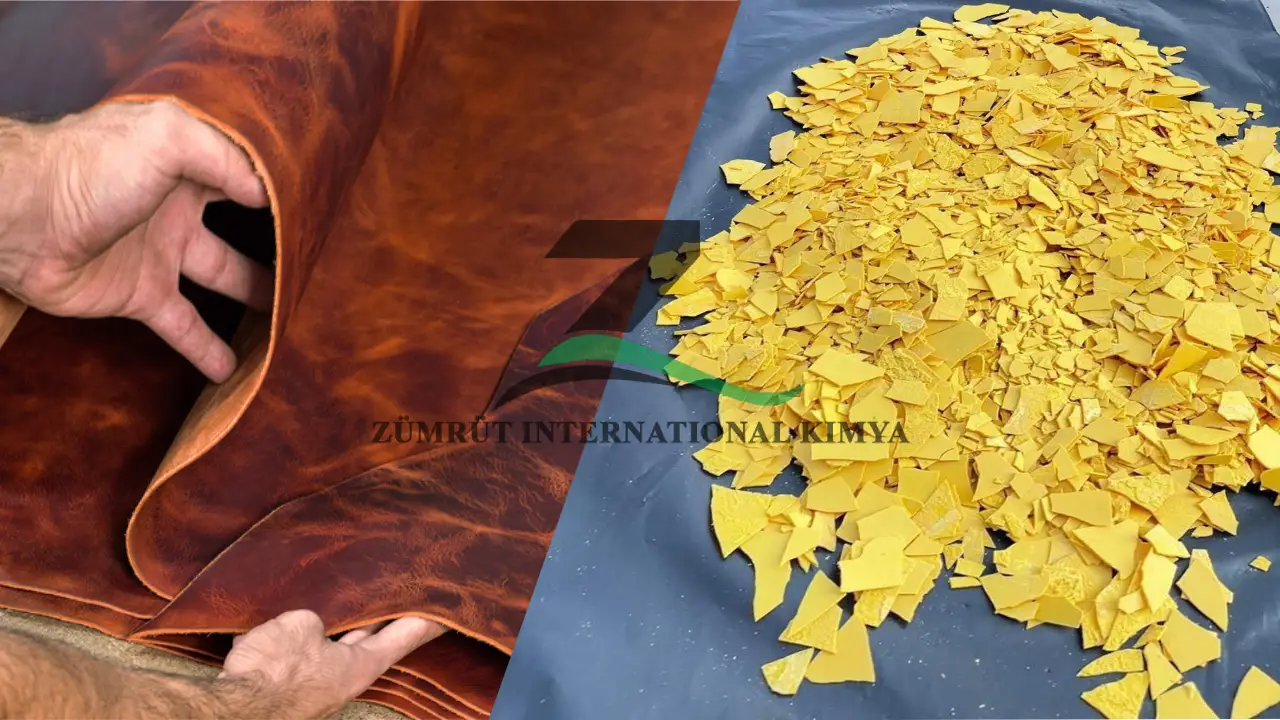
Premium-quality Na₂S 60% Flakes for unhairing, liming and soaking processes in tanneries worldwide. Trusted supplier from Turkey & Dubai — competitive pricing, fast global delivery.
Why Na₂S Matters
Why Sodium Sulphide for Leather Industry is Essential
Sodium sulphide (Na₂S) is the single most critical chemical in the beamhouse stage of leather production. Its primary function is to break down keratin — the protein that forms hair, wool and epidermis — allowing complete, clean removal from raw hides and skins without mechanical damage.
Without sodium sulphide, achieving uniform, damage-free dehairing at industrial scale is practically impossible. It acts as a powerful reducing agent, cleaving the disulfide bonds (–S–S–) in keratin’s molecular structure and dissolving hair roots deep in the follicle — resulting in smoother grain surfaces, improved dye penetration and higher-quality finished leather.
The use of sodium sulphide for leather industry has been the standard practice in tanneries for over a century.
Zumrut International Kimya supplies tannery-grade Na₂S 60% flakes to leather manufacturers across Asia, Middle East, Africa and Europe. Our product meets the strict purity requirements demanded by modern chrome and vegetable tanning operations.
⚡ Over 60–70% of global sodium sulphide consumption is driven by the leather & tanning industry — making it the single largest end-use market for Na₂S worldwide.
Step-by-Step Guide
Role of Sodium Sulphide at Each Stage
Na₂S plays a critical role across multiple beamhouse operations — from soaking to liming and beyond.
Soaking (Pre-Treatment)
Raw hides arrive either fresh, wet-salted or dried. A small addition of Na₂S (0.05–0.2%) to the soaking float begins softening the epidermis and initiating hair loosening without full dissolution.
Na₂S dose: 0.05–0.2%
Duration: 4–24h
pH: 9–10
Unhairing Bath (Core Application)
This is the primary application of sodium sulphide in tanneries. Na₂S is added to the drum together with slaked lime (Ca(OH)₂). The sulfide ions (S²⁻) attack the disulfide bridges (–S–S–) in the keratin protein chain of hair and epidermis, causing complete chemical dissolution of hair at the follicle level.
Unlike mechanical dehairing, this process leaves the grain layer intact and smooth — critical for premium leather grades (nappa, aniline, full-grain).
Na₂S dose: 2–3%
Lime dose: 4–8%
pH: 12–13
Temp: 20–25°C
Liming (Fibre Opening)
After unhairing, hides remain in the alkaline bath (lime + residual Na₂S) for the liming stage. This swells the collagen fibre structure, separating fibre bundles and removing non-structural proteins. Proper liming directly determines the softness and dye uptake of the finished leather.
Duration: 12–18h
Float: 300%
pH: 12+
Deliming & Bating
Excess alkali (including residual Na₂S) must be neutralized before enzymatic bating. Ammonium sulphate or CO₂ are commonly used. Proper washout of Na₂S at this stage is critical, as residual sulfide can interfere with enzyme activity.
Target pH: 8–9
Na₂S fully removed
Pickling & Tanning
Delimed hides move to pickling (acidification) then tanning — chrome (CrSO₄) or vegetable (tannins). Na₂S’s role is complete here, but the quality of unhairing and liming directly determines how well tanning agents penetrate the collagen structure.
Technical Specification
Technical Data Sheet — Na₂S 60% Flakes
Certified specifications for leather industry applications. Full COA available with every shipment.
| Parameter | Specification | Typical Result | Test Method | Status |
|---|---|---|---|---|
| Appearance | Yellow to red flakes | Yellow Flakes | Visual | ✔ PASS |
| Na₂S Content (%) | 60 ± 2% | 60.4% | Iodometric titration | ✔ PASS |
| Na₂SO₃ Content (%) | < 2.0% | 1.2% | Gravimetric | ✔ PASS |
| Na₂CO₃ Content (%) | < 0.5% | 0.3% | Acid-base titration | ✔ PASS |
| Iron (Fe, ppm) | < 10 ppm | 6 ppm | AAS / ICP | ✔ PASS |
| Insoluble Content (%) | < 1.2% | 0.9% | Filtration gravimetric | ✔ PASS |
| Density (g/cm³) | 1.580 – 1.620 | 1600 | Pycnometer | ✔ PASS |
| Melting Point (°C) | 89 – 95°C | 92°C | DSC / Capillary | ✔ PASS |
| pH (5% solution) | 12.5 – 13.5 | 13.1 | pH meter | ✔ PASS |
| Moisture Content (%) | < 3.0% | 1.8% | Karl Fischer | ✔ PASS |
| ★ All batches shipped with full COA (Certificate of Analysis) and MSDS. SGS-inspected shipments available on request. | ||||
Application Guide
Dosage Guide by Hide Type
Standard parameters for sodium sulphide in unhairing and liming process per hide type.
(% weight hide)
(combined)
Temperature
Duration
| Hide Type | Na₂S Dose | Lime | Float | Duration | Target pH |
|---|---|---|---|---|---|
| Bovine / Cattle (fresh) | 2.0 – 2.5% | 5 – 7% | 250–300% | 12–16 h | 12.5–13.0 |
| Bovine / Cattle (salted) | 2.5 – 3.0% | 6 – 8% | 300% | 14–18 h | 12.5–13.5 |
| Sheep / Lamb Skin | 1.5 – 2.0% | 3 – 5% | 200–250% | 8–12 h | 12.0–12.5 |
| Goat / Kid Skin | 1.5 – 2.0% | 3 – 5% | 200% | 8–12 h | 12.0–12.5 |
| Buffalo Hide | 2.5 – 3.5% | 6 – 9% | 300–350% | 16–24 h | 12.5–13.5 |
| Pig Skin | 2.0 – 2.5% | 4 – 6% | 250% | 10–14 h | 12.0–13.0 |
| Note: Dosages are guides based on industry standards. Always conduct small-scale trials before full production batches. | |||||
Why Choose Us
Why Tanneries Choose Zumrut International Kimya
We are more than a supplier — we are a long-term chemical partner for the leather industry.
Consistent Purity
Every batch quality-tested before dispatch. Full COA with every shipment — Na₂S 60±2%, Fe <10 ppm, Na₂CO₃ <0.5%.
Global Shipping
Warehousing in Ankara (Turkey) and Business Bay (Dubai, UAE). Fast delivery to Asia, Middle East, Africa and Europe. FCL and LCL available.
Competitive Pricing
Direct manufacturer relationships allow highly competitive prices per metric ton. Request a quote for volume pricing.
Full Documentation
COA, MSDS, Bill of Lading, SGS inspection reports and all export documentation provided with every shipment.
Flexible Packaging
Available in 25 kg PP bags, 500 kg and 1000 kg jumbo bags. Moisture-resistant packaging for maximum Na₂S shelf life.
Technical Support
Our team advises on optimal Na₂S dosage for different hide types, bath management and effluent treatment.
Safety & Handling
Safe Handling of Sodium Sulphide
Na₂S is a hazardous chemical. Proper handling protocols are essential for worker safety.
⚠️ Hazards to Be Aware Of
- ▸Releases toxic H₂S gas on contact with acids — rotten egg odor is a warning sign.
- ▸Strongly alkaline — causes severe burns to skin and eyes on contact.
- ▸Corrosive to metals; avoid contact with unlined iron drums.
- ▸Reacts vigorously with oxidizing agents (hydrogen peroxide, bleach).
- ▸H₂S above 100 ppm is immediately dangerous to life.
- ▸Never add Na₂S to acidic solutions — explosive H₂S release possible.
✅ Safe Handling Practices
- ▸Always wear full PPE: chemical-resistant gloves, face shield, rubber apron and safety boots.
- ▸Ensure adequate ventilation — install H₂S gas detectors in beamhouse zones.
- ▸Store in sealed, moisture-proof containers in a cool, dry area away from acids.
- ▸Add Na₂S slowly to water — never add water to dry flakes (exothermic).
- ▸Tannery effluent containing Na₂S must be treated before discharge per local regulations.
- ▸Emergency: flush with large amounts of water for 15 minutes. Seek medical attention immediately.
FAQ
Sodium Sulphide in Leather — FAQ
Common questions from tannery buyers and leather processing engineers.
+
Sodium sulphide provides sulfide ions (S²⁻) in alkaline solution. These ions selectively cleave the covalent disulfide bonds (–S–S–) within the keratin protein structure of hair. Once broken, the keratin dissolves — resulting in complete chemical dissolution of hair at the follicle, leaving a clean grain surface free of hair root remnants.
+
The industry standard is Na₂S 60% ± 2%, supplied as yellow flakes. This grade provides the right balance of active sulfide content, handling safety, and cost efficiency. The 60% flake grade is the worldwide standard for tannery use.
+
Na₂S and lime (Ca(OH)₂) serve complementary functions. Na₂S dissolves keratin (hair). Lime provides sustained alkalinity (pH 12+) needed to swell and open the collagen fibre structure — essential for tanning agent penetration. Their combination is the cornerstone of classic tannery chemistry.
+
Treatment options include: (1) Oxidation with H₂O₂ — converts S²⁻ to sulfate; (2) Aeration — oxidizes sulfide to thiosulfate/sulfate; (3) Precipitation using iron salts (FeSO₄). All tannery effluent must comply with local discharge standards (typically <1–2 mg/L total sulfide).
+
Na₂S flakes have a shelf life of 12–24 months when stored correctly in sealed, moisture-proof packaging in a cool, dry area (below 30°C). Our jumbo bag packaging uses multi-layer moisture barriers to maximize shelf life during transport and storage.
Ready to Source Sodium Sulphide for Your Tannery?
Get a competitive price quote from Zumrut International Kimya — Turkey & Dubai. Fast response within 24 hours.
📍 Business Bay, Dubai · +971 50 334 5424
✉️ info@zumrut-int.com