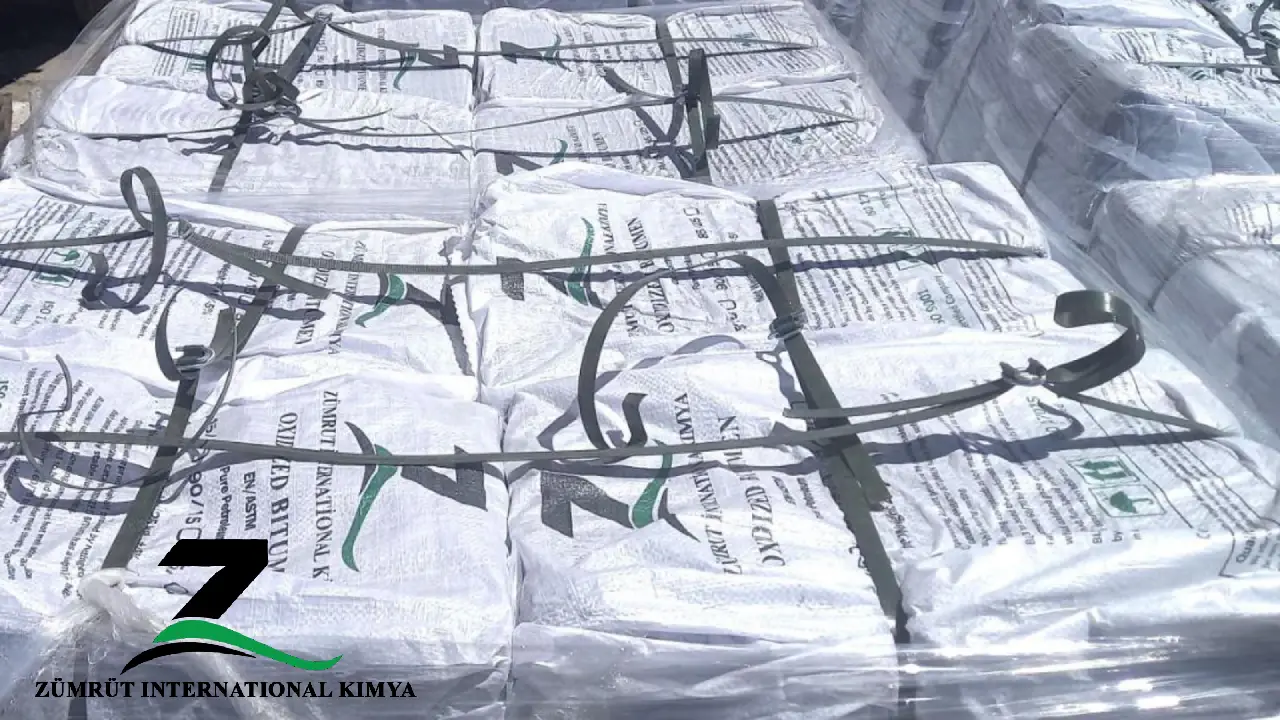
- What Is Oxidized Bitumen 115/15?
- Oxidized Bitumen 115/15 Full Technical Specifications
- How Is Oxidized Bitumen 115/15 Produced?
- Oxidized Bitumen 115/15 vs Other Oxidized Grades
- Oxidized Bitumen 115/15 Applications
- Packing Options for Oxidized Bitumen 115/15
- HS Code for Oxidized Bitumen 115/15
- Storage & Handling of Oxidized Bitumen 115/15
- Export Markets — Where We Ship Oxidized Bitumen 115/15
- Frequently Asked Questions — Oxidized Bitumen 115/15
- Related Products & Pages
Oxidized Bitumen 115/15 is a hard, air-blown bitumen with softening point 115°C, supplied FOB Iskenderun and Mersin, Turkey.
Oxidized Bitumen 115/15
Hard-grade blown asphalt for roofing, waterproofing, pipe coating and industrial applications. ASTM D312 & EN 13304 compliant. FOB Iskenderun & Mersin, Turkey.
🚢 FOB Iskenderun & Mersin
📋 Full COA & MSDS
🌍 30+ Countries
What Is Oxidized Bitumen 115/15?
Oxidized Bitumen 115/15 is a thermoplastic hydrocarbon material produced by blowing hot air through penetration grade bitumen (typically 60/70) at controlled temperatures of 240–270°C. This air-blowing process — also known as oxidation — increases the softening point and reduces the penetration value, producing a harder, more temperature-resistant material than standard paving bitumen. The designation “115/15” refers to two key properties: a softening point of 115°C (Ring & Ball method) and a penetration of 15 tenths of a millimeter (dmm) at 25°C.
Oxidized Bitumen 115/15 is the single most produced and traded grade of oxidized (blown) bitumen worldwide. It accounts for the majority of global oxidized bitumen demand due to its exceptional combination of high-temperature stability, waterproofing performance, adhesion, and chemical resistance. It is the standard specification for roofing felt manufacturing, modified bitumen membrane production, pipe anti-corrosion coatings, and industrial sealant applications across the Middle East, Africa, Europe, and Asia.
Zumrut International Kimya supplies Oxidized Bitumen 115/15 FOB Iskenderun and Mersin, Turkey, compliant with ASTM D312 and EN 13304, with full Certificate of Analysis (COA) and MSDS for every shipment. Export to 30+ countries.
Oxidized Bitumen 115/15 Full Technical Specifications
| Property | Test Method | Unit | Specification |
|---|---|---|---|
| Softening Point (Ring & Ball) | ASTM D36 / EN 1427 | °C | 110–120 |
| Penetration at 25°C, 100g, 5s | ASTM D5 / EN 1426 | dmm | 10–20 |
| Specific Gravity at 25°C | ASTM D70 | g/cm³ | 1.01–1.06 |
| Flash Point (Cleveland Open Cup) | ASTM D92 | °C | ≥ 250 |
| Solubility in CS₂ | ASTM D4 | wt % | ≥ 99 |
| Loss on Heating (163°C, 5h) | ASTM D6 | wt % | ≤ 0.2 |
| Ductility at 25°C | ASTM D113 | cm | ≥ 1.5 |
| Viscosity at 135°C | ASTM D2170 | cSt | Report |
| Density at 25°C | ASTM D70 | kg/m³ | 1,010–1,060 |
| Spot Test | AASHTO T102 | — | Negative |
📄 Download Oxidized Bitumen 115/15 Specification Sheet (PDF)
How Is Oxidized Bitumen 115/15 Produced?
Oxidized Bitumen 115/15 is manufactured through a controlled air-blowing process applied to penetration grade bitumen 60/70. The process transforms the base bitumen’s chemical and physical properties by increasing its molecular weight, reducing temperature susceptibility, and raising the softening point. The four stages of production are:
🛢️
Base Bitumen Heating
Penetration grade bitumen 60/70 is heated to 240–270°C in a closed oxidation vessel under controlled conditions.
💨
Air Injection
Compressed hot air is injected through the heated bitumen at a controlled rate. Oxygen reacts with bitumen molecules in an exothermic reaction.
⚗️
Oxidation & Hardening
The reaction increases molecular weight and cross-links polymer chains, raising softening point to ~115°C and reducing penetration to ~15 dmm.
✅
QC Testing & Packing
Product is tested against ASTM D312 / EN 13304 specifications. COA issued and material packed in kraft bags, meltable bags, or drums.
Oxidized Bitumen 115/15 vs Other Oxidized Grades
Understanding where 115/15 sits within the oxidized bitumen grade range helps buyers specify the correct product for their application:
| Grade | Softening Point (°C) | Penetration (dmm) | Hardness | Primary Use |
|---|---|---|---|---|
| 85/25 | 80–90 | 20–30 | Medium | Roofing, waterproofing membranes |
| 90/40 | 85–95 | 35–45 | Medium-soft | Flexible waterproofing, cold climates |
| 95/25 | 90–100 | 20–30 | Medium-hard | Industrial roofing, pipe coating |
| 115/15 | 110–120 | 10–20 | Hard | Roofing felt, pipe coating, automotive |
| 105/35 | 100–110 | 30–40 | Hard-flexible | Modified membranes, industrial sealants |
| 150/5 | 145–155 | 3–7 | Very hard | Electrical insulation, specialty coatings |
Oxidized Bitumen 115/15 Applications
🏠
Roofing Felt & Membrane Manufacturing
The primary application globally. Used as the base impregnant for roofing felt and as the coating compound in modified bitumen membranes (SBS and APP). High softening point prevents flow at elevated roof temperatures.
💧
Waterproofing & Damp-Proofing
Applied to foundations, basements, bridge decks, tunnels, and retaining walls as a waterproofing barrier. Excellent adhesion to concrete and masonry combined with impermeability to water makes it ideal for below-grade applications.
🔩
Pipe Anti-Corrosion Coating
Used as anti-corrosion wrapping for buried steel pipelines (oil, gas, water). Applied as hot-applied coating or in cold tape form. Resistant to soil chemicals, moisture, and cathodic disbonding. Complies with DIN 30672 and EN 10300.
🚗
Automotive Underbody Sealants
Applied as sound-dampening and anti-corrosion undercoating on vehicle chassis and body panels. High hardness and adhesion to metal substrates, combined with vibration-damping properties, make it the standard specification for OEM automotive sealing.
⚡
Electrical Cable & Joint Protection
Used in cable joint filling compounds, electrical insulation tapes, and transformer oil additives. High dielectric strength and chemical resistance make oxidized bitumen 115/15 suitable for high-voltage cable protection applications.
🏭
Industrial Flooring & Pavement
Applied in bituminous industrial floor coatings, anti-slip layer compounds in the piling industry, and port terminal pavement in very hot climates. Also used in hydraulic structures, dam facings, and canal linings requiring permanent waterproofing.
🎾
Synthetic Turf Base & Sports Surfaces
Used as the binder in shock-pad layers under artificial grass systems for football pitches, running tracks, and tennis courts. The combination of hardness and rubber-like elasticity provides the required cushioning and drainage properties.
🎨
Bituminous Paints & Coatings
Used as the base in bitumen-based anticorrosion paints and lacquers for metal structures, storage tanks, and public works infrastructure. Dissolved in solvent to produce black bituminous paint for structural steel protection.
🌊
Marine & Hydraulic Applications
Applied in marine mastic, harbor sealing, and offshore structure protection. Used in grouted mattresses for scour protection and in canal and reservoir linings. Resists saltwater, wave action, and UV degradation in coastal environments.
Packing Options for Oxidized Bitumen 115/15
| Packing Type | Unit Weight | Loading / Container | Best For |
|---|---|---|---|
| Kraft Paper Bag (25 kg) | 25 kg | ~800 bags / 20 MT per 20ft FCL | Roofing felt manufacturers, retail |
| Meltable Polyethylene Bag (25 kg) | 25 kg | ~800 bags / 20 MT per 20ft FCL | Easy melting in plant, no waste |
| Carton on Pallet (25 kg bags) | 25 kg | 20 MT per 20ft FCL | Forklift handling, warehouse storage |
| New Steel Drum | 180 kg | ~110 drums (~20 MT) | Industrial contractors, small batches |
| Jumbo Bag | 1,000 kg | 20 MT per 20ft FCL | Large industrial plants |
| Bulk in Vessel | — | 2,000–20,000 MT | Large-scale industrial projects |
HS Code for Oxidized Bitumen 115/15
Chapter 27 — Mineral fuels & petroleum products
Applies to all oxidized bitumen grades: 85/25, 90/40, 95/25, 105/15, 105/35, 115/15, 150/5
Storage & Handling of Oxidized Bitumen 115/15
| Parameter | Guideline |
|---|---|
| Storage temperature (solid packed) | Ambient — no heating required |
| Melting temperature for application | 160–180°C |
| Maximum heating temperature | ≤ 220°C (avoid flash point) |
| Shelf life (sealed packaging) | 24 months |
| Storage environment | Dry, covered, away from direct sunlight |
| Fire classification | Combustible solid — Flash Point ≥ 250°C |
| PPE required | Heat-resistant gloves, safety glasses, long sleeves when handling molten material |
Export Markets — Where We Ship Oxidized Bitumen 115/15
Zumrut International Kimya exports Oxidized Bitumen 115/15 to buyers across more than 30 countries through Iskenderun and Mersin ports in Turkey:
🇾🇪 Yemen
🇰🇪 Kenya
🇧🇷 Brazil
🇻🇳 Vietnam
🇰🇼 Kuwait
🇰🇭 Cambodia
🇦🇪 UAE
🇱🇷 Liberia
🇨🇱 Chile
🇹🇷 Turkey
🇲🇾 Malaysia
🇨🇳 China
🇹🇭 Thailand
🇲🇿 Mozambique
🇨🇩 Congo
🇹🇿 Tanzania
🇲🇲 Myanmar
🇩🇯 Djibouti
🇹🇼 Taiwan
🇴🇲 Oman
🇬🇪 Georgia
🇸🇩 Sudan
🇵🇪 Peru
🇮🇳 India
🇰🇷 South Korea
🇵🇭 Philippines
🇮🇩 Indonesia
🇿🇦 South Africa
🇶🇦 Qatar
🇷🇼 Rwanda
🇸🇴 Somalia
🇷🇴 Romania

Frequently Asked Questions — Oxidized Bitumen 115/15
What does 115/15 mean in oxidized bitumen?
What is the difference between oxidized bitumen and penetration grade bitumen?
What is the softening point of oxidized bitumen 115/15?
What standards does Blown Asphalt 115/15 comply with?
What is the melting temperature for oxidized bitumen 115/15?
What is the difference between oxidized bitumen 115/15 and 85/25?
What is the HS code for oxidized bitumen 115/15?
What packing is available for oxidized bitumen 115/15?
Related Products & Pages
| Oxidized Bitumen 105/35 Flexible grade for modified membranes |
Oxidized Bitumen 95/25 Medium-hard grade for industrial roofing |
Oxidized Bitumen 85/25 Softer grade for cold climate waterproofing |
| Oxidized Bitumen 150/5 Very hard grade for electrical insulation |
All Oxidized Bitumen Grades Complete oxidized grade range overview |
Bitumen 60/70 Base material used to produce oxidized grades |
Request a Quote — Oxidized Bitumen 115/15 FOB Turkey
Tell us your required quantity, packing type (kraft bags, meltable bags, drums), and destination port. We respond within 24 hours with a competitive FOB price and full documentation.