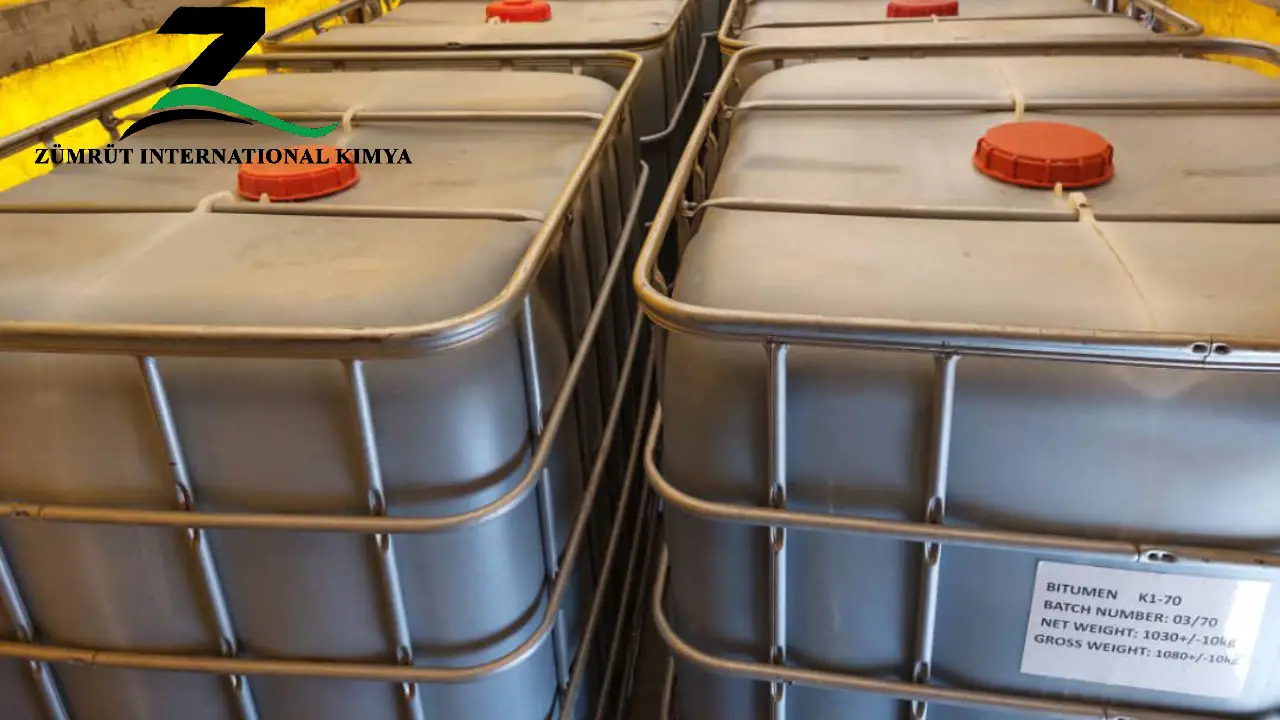
Cationic Bitumen Emulsion Description
Cationic Bitumen Emulsion is a water-based mixture in which tiny particles of bitumen are dispersed in water with the aid of a cationic (positively charged) emulsifying agent. The cationic charge allows the bitumen droplets to bond more effectively with negatively charged surfaces like aggregates in road construction. This strong adhesion enhances the performance of asphalt layers, especially in road building and maintenance applications.
Composition:
- Bitumen: The primary binder in the emulsion, typically comprising 40-70% of the total mixture.
- Water: Serves as the carrier, dispersing the bitumen particles in a fluid form.
- Emulsifying Agent: A cationic surfactant that ensures the stable suspension of bitumen in water by imparting a positive charge to the bitumen droplets.
- Additives: Depending on the specific formulation, other chemicals may be added to enhance the emulsion's properties, such as setting time and viscosity.
Types of Cationic Bitumen Emulsions:
- Rapid Setting (RS): Sets quickly upon contact with aggregate, ideal for surface dressing or sealing.
- Medium Setting (MS): Designed for mixes like cold mixes, allowing more time for workability before setting.
- Slow Setting (SS): Used in slurry seal applications and allows for greater flexibility and longer working times.
A stable dispersion of bitumen in water in the continuous phase. The bitumen globules are positively charged due to the NH3 + group cover which is formed around bitumen droplets and provide stability for emulsion by electrostatic repulsion. These bitumen droplets have an affinity with the negatively charged aggregate, which is usually available in India. Dispersion is obtained by processing bitumen & water-based solution under controlled conditions through a colloidal mill having a high-speed rotor in the presence of scientifically selected surfactants/emulsifier. Selection of emulsifier & its quality is significant for emulsion stability, it's breaking & curing when applied over aggregates. The Cationic Bitumen Emulsion is chocolate brown and free-flowing at normal temperature. Once it breaks the bitumen breaks out and color changes to black. An Emulsion is said to break when the organic and the aqueous phase separate into two distinct layers i.e. the dispersion ceases to exist. Emulsions are classified as Rapid Setting-1(RS-1), Rapid Setting-2(RS-2), Medium Setting (MS), Slow Setting-1 (SS-1) and Slow Setting-1 h (SS-1h). The breaking time varies according to the designation of Emulsion although being largely dependent upon the climatic condition i.e. temperature, humidity, wind velocity etc.
The term cationic is derived from the migration of particles of bitumen under an electric field also. The droplets migrate toward the cathode (negative electrode), and hence the emulsion is called cationic. The cationic emulsifying agent functions similarly to the anionic; the negative portion of the head floats around in the water leaving a positively charged head. This imparts a positive charge to all the droplets. Since positives repel each other, all the droplets repel each other and remain as distinct bitumen drops in suspension. A typical cationic emulsifying agent is shown below showing the orientation of the agent at the bitumen-water interface and the positive charge imparted to each drop.
| Cationic Emulsion bitumen | ||
| CRS | CMS | CSS |
| CRS-1 | CMS-2 | CSS-1 |
| CRS-2 | CMS-2h | CSS-1h |
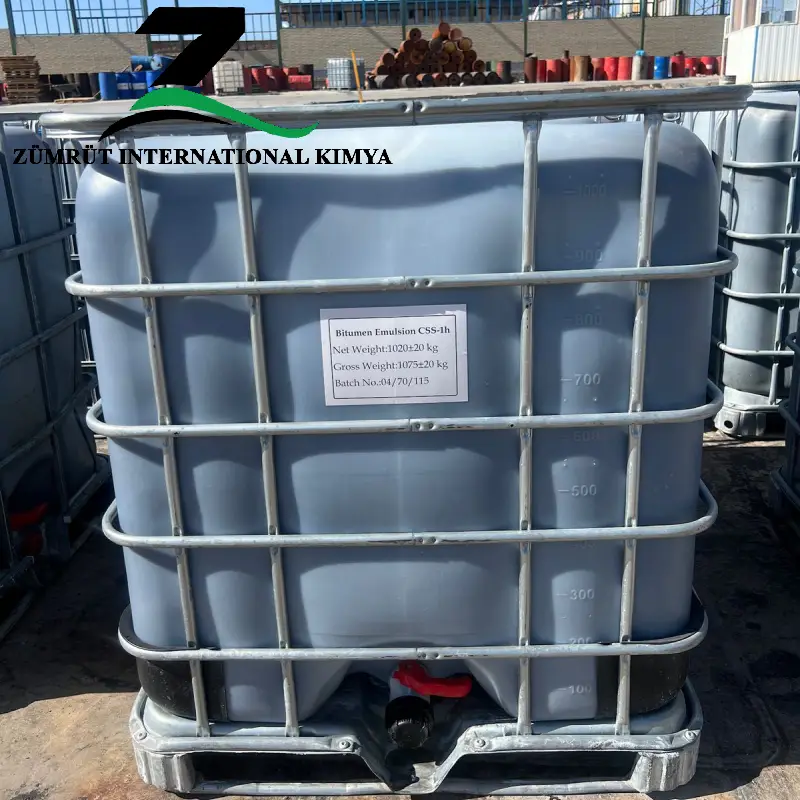
Cationic type: In which the bitumen particles are positively charged and the emulsifier used is a long chain amine. These are suitable for use with siliceous aggregates like quartzite, sandstone, granite etc.
When the emulsion is being produced the cations are adsorbed by bitumen droplets, negatively ions remain in the water. The undeniably most complete field of use is represented by the rapid setting emulsions.
The choice of bitumen emulsion (i.e. whether anionic or cationic) to be used depends upon the mineral composition of aggregate used for construction. In the case of silica-rich aggregates, the surface of the aggregates is electronegatively charged. Therefore a cationic bitumen emulsion should be used. This will help better spreading and binding of bitumen with aggregates.
Cationic Bitumen Emulsion is a type of bitumen emulsion where the bitumen particles carry a positive charge (cationic). This positive charge allows the emulsion to bind more effectively to negatively charged surfaces, such as stone aggregates and other road construction materials. This makes it an ideal choice for road construction, maintenance, and repair, as it provides strong adhesion and rapid setting.
Key Characteristics of Cationic Bitumen Emulsion:
- Fast Setting: Due to the positive charge, cationic bitumen emulsions break and set quickly, making them highly efficient in road construction processes.
- Strong Adhesion: The cationic nature allows it to bond exceptionally well with negatively charged surfaces like aggregates, leading to stronger and more durable roads.
- Cold Application: Cationic bitumen emulsions can be applied at ambient temperatures, reducing the need for heating and making the process safer and more environmentally friendly.
- Versatility: It is used in a variety of road applications, including surface dressing, tack coats, and slurry seals.
Applications of Cationic Bitumen Emulsion:
- Tack Coating: Used as a bonding layer between old and new asphalt, ensuring a strong adhesion between layers.
- Surface Dressing: Improves skid resistance and extends the life of road surfaces by providing a protective layer.
- Slurry Seals: Applied to repair worn road surfaces and improve water resistance and durability.
- Cold Mix Asphalt: It is used in cold mix applications, reducing energy consumption and emissions during road construction.
Advantages of Cationic Bitumen Emulsion:
- Energy Efficiency: Applied cold, reducing the need for heating and lowering energy costs.
- Cost-Effective: Lowers overall construction and maintenance costs while improving road durability.
- Environmental Benefits: Reduces emissions and energy consumption due to cold application and fewer resources needed.
- High Performance: Offers excellent bonding and durability, even in adverse weather conditions..