Zumrut International Kimya ships bulk petroleum jelly to South Africa in four grades: Snow White, Pharma, Cosmetic and Industrial. We load at Jebel Ali (UAE) and Iskenderun (Turkey) and then deliver to Durban, Cape Town and Ngqura. Most of our buyers make cosmetics, hair care and pharmaceuticals in Gauteng, KwaZulu-Natal and the Western Cape. Every container also carries a certificate of analysis, a safety data sheet and the documents that SARS and ITAC ask for. The minimum order is one 20 ft container, about 19 MT in 175 kg drums.
Updated 4 November 2026 · Prepared by the Zumrut International Kimya export team, Ankara and Dubai
South Africa at a glance:
- Petroleum jelly is on South Africa’s import control list, so the importer needs an ITAC permit before loading.
- The importer also needs a SARS customs client number.
- Bulk packs over 5 kg fall under tariff 2712.10.20, with a 12.5% general duty rate plus 15% VAT.
- In 2024, India alone shipped about 845 MT of petroleum jelly worth USD 1.38 million to South Africa (World Bank WITS).
Contents13 sections
The Petroleum Jelly Market in South Africa
South Africa has the largest personal-care manufacturing base in Southern Africa. Petroleum jelly, also called vaseline, is a household staple for skin care. In addition, local plants use it as a core raw material for baby care, hair products, ointments and aqueous creams. Most brands therefore buy it in bulk and fill it in their own plants. For example, World Bank WITS data show that India alone shipped about 845 MT of petroleum jelly to South Africa in 2024.
For a manufacturer who buys petroleum jelly in South Africa, three things matter most. First, colour and drop point must stay steady from lot to lot. Second, the ITAC permit must be valid before loading. Finally, the invoices must clear SARS without queries. South Africa also belongs to the Southern African Customs Union (SACU) with Botswana, Lesotho, Namibia and Eswatini, and all five share one external tariff.
Note on the name: Vaseline® is a registered trademark of Unilever. Zumrut supplies generic petroleum jelly (white petrolatum) in bulk and has no link to the brand.
Petroleum Jelly Grades for South Africa
| Grade | Colour | Drop Point | Typical Use in South Africa |
|---|---|---|---|
| Snow White | Lovibond ≤ 0.5 Y | 56–60 °C | Premium body jelly and baby products |
| Pharma | Lovibond ≤ 0.7 Y | 54–58 °C | Ointment bases and aqueous creams |
| Cosmetic | Lovibond ≤ 1.0 Y | 52–56 °C | Body jelly, hair grease, lotions and lip care |
| Industrial | Yellow to amber | 38–54 °C | Lubrication, anti-rust, mining and cable protection |
These are typical values. However, the certificate of analysis that comes with every lot of petroleum jelly for South Africa holds the binding values. For full specifications, see also our main petroleum jelly page.
Main Uses of Petroleum Jelly in South Africa
Most buyers of petroleum jelly in South Africa use it in one of these ways:
- Body and baby jelly: the largest volume use, filled in tubs and jars for local brands.
- Hair products: hair grease, pomades and scalp-protection products blended with mineral oil and fragrance.
- Cosmetics: lotions, creams and lip care.
- Pharmaceuticals: white soft paraffin for ointments and aqueous cream bases.
- Industry and mining: light lubrication, rust protection, battery terminals and cable protection.
Finished cosmetics in South Africa fall under the Foodstuffs, Cosmetics and Disinfectants Act 54 of 1972. In addition, their labels must be in English at minimum. For skin-care formulations, see petroleum jelly for moisturizers.
How to Import Petroleum Jelly Into South Africa
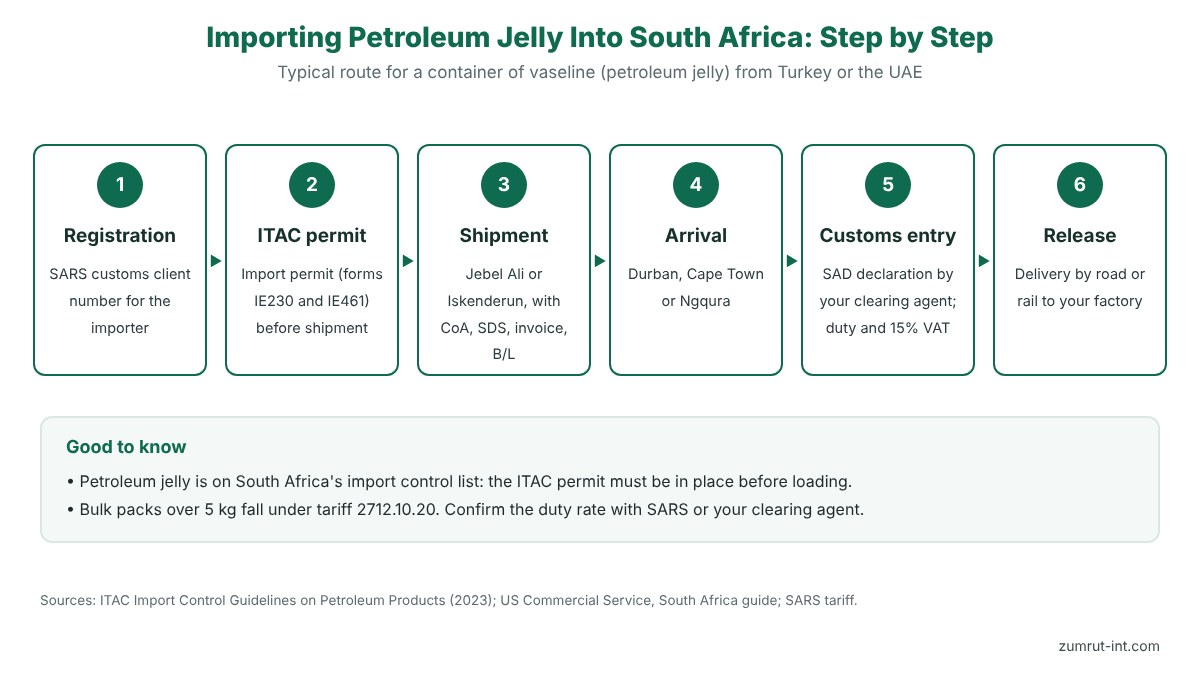
- SARS registration: first, the importer registers with SARS Customs and receives a customs client number.
- ITAC import permit: next, the importer registers with ITAC (form IE230) and applies for a permit (form IE461). After that, ITAC usually issues permits within about five working days.
- Shipment: we then load the container and send the commercial invoice, packing list, certificate of origin, certificate of analysis, SDS and bill of lading.
- Arrival: the vessel discharges the container at Durban, Cape Town or Ngqura.
- Customs entry: your clearing agent then files the declaration (SAD) with SARS and pays duty and VAT.
- Release: finally, SARS releases the container, and a truck or train takes it to your factory.
Permit first, then loading: the ITAC permit must be valid before we ship the goods. So send us the permit number, tariff code and quantity, and we will match our invoice to it exactly.
Import Duty on Petroleum Jelly in South Africa
| Tariff Line | Pack Size | General Rate | EU / EFTA / SADC |
|---|---|---|---|
| 2712.10.10 | Packs of 5 kg or less (retail) | 20% | Free |
| 2712.10.20 | Packs over 5 kg (drums, bulk) | 12.5% | Free |
Our drums and flexitanks fall under 2712.10.20. Goods from Turkey or the UAE usually pay the general rate, and 15% VAT also comes on top. However, rates can change, so confirm them with SARS or your clearing agent before you order.
Documents From Your Petroleum Jelly Supplier
We send these documents with every container to South Africa:
| Document | Why South Africa Needs It |
|---|---|
| Commercial invoice | Customs valuation. SARS asks for a full description of the goods and refuses zero-value invoices. |
| Packing list | Customs declaration and examination |
| Bill of lading | Release of the container at the port |
| Certificate of origin | Proof of origin for duty assessment |
| Certificate of analysis and SDS | Quality check at your plant and safe handling |
On request, we can also arrange independent inspection at loading by SGS, Bureau Veritas or Intertek.
Ports in South Africa for Petroleum Jelly Imports
| Port | Notes |
|---|---|
| Durban | The main container gateway and the closest port to Gauteng by road and rail. The World Bank ranked it the most improved port globally in 2026. |
| Cape Town | The best choice for buyers in the Western Cape. |
| Ngqura (Gqeberha) | A deep-water container port for the Eastern Cape. |
| Onward to SACU | Cargo for Botswana, Lesotho and Eswatini usually moves through Durban. |
In addition, Transnet reported 7.1% growth in container volumes for 2025/26. We quote CFR Durban, CFR Cape Town or CFR Ngqura. For neighbouring markets, see also our pages for Namibia, Mozambique and Zambia.
Petroleum Jelly Shipment Planner for South Africa
First choose the packing, then enter the quantity. The planner then shows how many drums and containers your order needs.
Packaging and Container Loading
We offer four packing options for South Africa:
| Packing | Net Weight | Units per 20 ft | Net per 20 ft |
|---|---|---|---|
| New steel drum | 175 kg | 110 drums | ≈ 19.25 MT |
| New PE drum | 100 kg | 180 drums | ≈ 18.0 MT |
| New PE drum | 50 kg | 300 drums | ≈ 15.0 MT |
| Flexitank or ISO tank | Bulk | 1 tank | 18–24 MT |
Terms of Supply and Price
These are our standard terms for South Africa:
- Minimum order: one 20 ft container.
- Incoterms: FOB Jebel Ali or FOB Iskenderun. CFR Durban, Cape Town or Ngqura on request.
- Payment: T/T.
- Samples: pre-shipment samples for formulation trials.
Current prices for every grade appear on our petroleum jelly price page. For a CFR price, just send us the grade, packing, quantity and port.
Why Buy Petroleum Jelly in South Africa From Zumrut
Manufacturers choose Zumrut for petroleum jelly in South Africa for four reasons:
- Permit-matched invoices: our invoices follow your ITAC permit and tariff code exactly.
- Two loading ports: Jebel Ali and Iskenderun give flexible sailings to Durban and Cape Town.
- Full documents: a certificate of analysis and SDS with every container.
- Four grades from one supplier: from Snow White to Industrial, for cosmetic, pharma and technical lines.
Frequently Asked Questions
Do I need an ITAC permit to import petroleum jelly into South Africa?
Yes. Petroleum jelly is on South Africa’s import control list, so the importer needs an ITAC permit before shipment. The forms are IE230 and IE461, and ITAC usually issues permits within about five working days.
What is the import duty on petroleum jelly in South Africa?
Bulk packs over 5 kg fall under tariff 2712.10.20, with a 12.5% general rate plus 15% VAT. Retail packs of 5 kg or less, on the other hand, fall under 2712.10.10 at 20%. However, rates can change, so confirm them with SARS.
Which port is best for shipping petroleum jelly to Johannesburg?
Durban, because it is the closest port to Gauteng by road and rail. It also handles most of South Africa’s container imports.
Which grade is best for hair grease and body jelly?
In general, most brands choose Cosmetic grade for hair grease and body jelly. For premium and baby products, however, they use Snow White because it has the lightest colour.
Do you supply the Vaseline brand?
No. Vaseline® is a registered trademark of Unilever. Instead, we supply generic petroleum jelly, also called white petrolatum or white soft paraffin, in bulk for manufacturers.
What is the minimum order of petroleum jelly to South Africa?
One 20 ft container, which holds about 19 MT in 175 kg steel drums or 18 MT in 100 kg PE drums.
References
- Import Control Guidelines on Petroleum Products (March 2023) — International Trade Administration Commission (ITAC).
- Import or export permits for petroleum products — South African Government.
- South Africa Country Commercial Guide: Import Requirements and Documentation — US International Trade Administration.
- SA Customs Tariff, heading 2712 — Freight News.
- Transnet records 9% rise in vessel traffic as port operations improve — SAnews.
- World Bank ranks Durban port as most improved globally — TimesLIVE.
- South Africa cosmetic regulation — ChemLinked.
- India petroleum jelly exports by country, 2024 (HS 271210) — World Bank WITS.
Request a Petroleum Jelly Quote for South Africa
Send us the grade, packing, quantity and port, together with your ITAC permit details. Our team will then reply with a certificate of analysis from a recent lot and a CFR quotation.
Request a South Africa Quote →
Email info@zumrut-int.com · Phone +90 312 544 45 81 · WhatsApp +90 501 003 88 00 · +971 50 334 5424