- What Is Industrial Grade Petroleum Jelly?
- Why Industrial Grade Petroleum Jelly Outperforms Alternatives
- Technical Data Sheet – Industrial Grade Petroleum Jelly
- Industrial vs Cosmetic vs Pharma Grade – Quick Comparison
- Industrial Grade Petroleum Jelly Uses by Sector
- Industrial Grade Petroleum Jelly Price – FOB June 2026
- Packaging & Container Load
- Export Destinations
- Frequently Asked Questions
- Related Products
Industrial grade petroleum jelly — also known as yellow petrolatum, industrial vaseline, or technical grade petroleum jelly — is a minimally refined semi-solid hydrocarbon used across manufacturing, electrical, automotive, and infrastructure industries. Unlike cosmetic or pharma grades, it retains its natural yellow to amber color and is optimized for performance in non-skin-contact applications where cost efficiency matters most. Zumrut International Kimya supplies industrial grade petroleum jelly in bulk from Turkey (FOB Iskenderun) and UAE (FOB Jebel Ali) with fast loading, competitive FOB pricing, and full export documentation.
Definition
What Is Industrial Grade Petroleum Jelly?
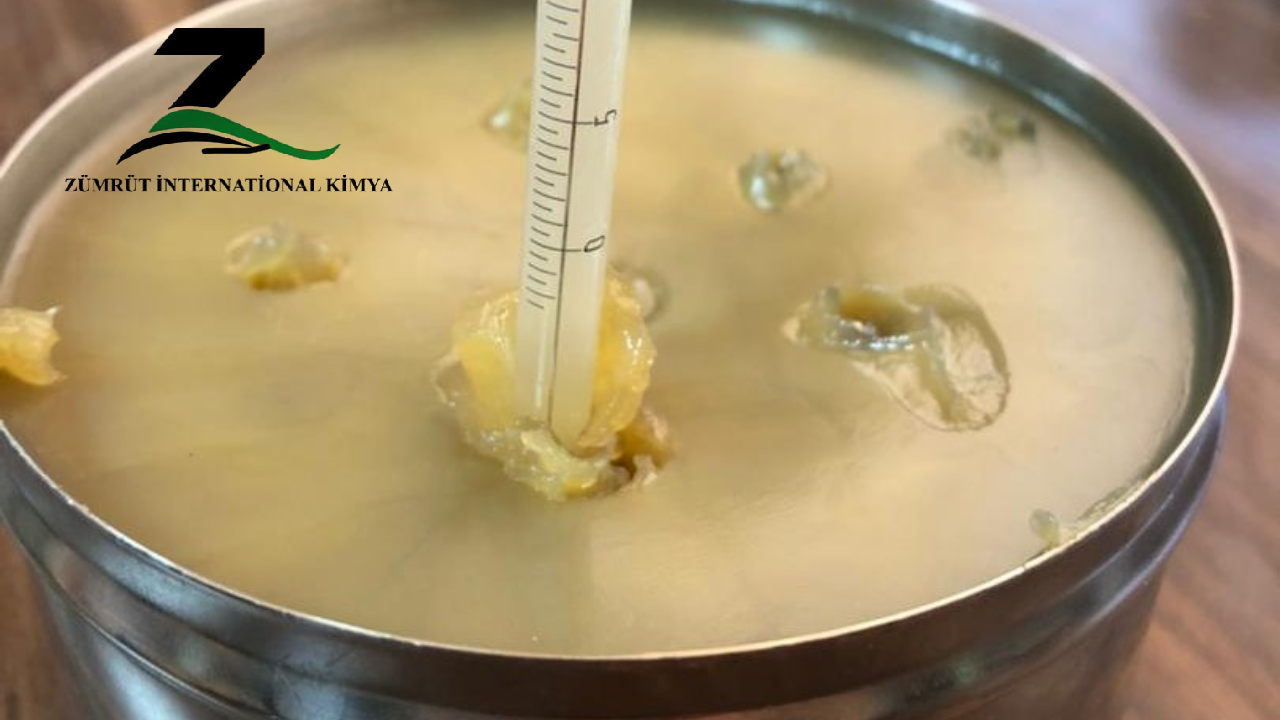
Industrial grade petroleum jelly is a semi-solid mixture of long-chain hydrocarbons (C25–C45) derived from the refining of crude oil. It undergoes fewer purification steps than cosmetic or pharma grades, which means it retains trace color bodies and a slight petroleum odor — but also retains a higher concentration of natural wax components that make it an excellent lubricant, moisture barrier, and corrosion inhibitor for demanding industrial environments.
The product is also referred to as yellow petroleum jelly, technical vaseline, amber petrolatum, or simply technical grade PJ in trade. It is not suitable for direct skin contact or pharmaceutical use, but for industrial buyers it offers the best cost-to-performance ratio among all petroleum jelly grades. Key performance properties include high water repellency, excellent adhesion to metal and rubber surfaces, wide operating temperature range, and long-term chemical stability.
Industrial buyers from the electrical cable industry, automotive sector, rubber manufacturing, and infrastructure maintenance consistently choose industrial grade petroleum jelly from ASTM-tested Turkish and UAE sources for its consistency, competitive FOB pricing, and reliable availability.
Key Properties
Why Industrial Grade Petroleum Jelly Outperforms Alternatives
Superior Lubrication
High viscosity index and excellent film strength make it an effective lubricant for slow-moving mechanical parts, threaded fasteners, and rubber-to-metal contact surfaces.
Corrosion Protection
Forms a water-impermeable barrier on metal surfaces, preventing oxidation, rust, and galvanic corrosion in harsh environments including marine and tropical climates.
Electrical Insulation
Non-conductive with a high dielectric strength. Widely used in cable filling compounds, switchgear protection, and connector sealing to prevent moisture ingress and short circuits.
Wide Temperature Range
Remains stable from -20°C to +120°C, making it suitable for outdoor infrastructure in both cold-climate and tropical applications without significant performance degradation.
Most Cost-Effective Grade
Lowest FOB price among all petroleum jelly grades. Ideal for large-volume industrial buyers where purity requirements of cosmetic or pharma standards are not needed.
Chemically Stable
Resistant to oxidation, hydrolysis, and microbial degradation. Shelf life of 3–5 years in sealed drums. Compatible with most rubber compounds, metals, and plastics.
Specifications
Technical Data Sheet – Industrial Grade Petroleum Jelly
| Parameter | Result | Test Method | Specification |
|---|---|---|---|
| Appearance | Semi-solid, yellow to amber | Visual | Homogeneous semi-solid mass |
| Color | Yellow / Amber | Visual / Lovibond | Not controlled |
| Odor | Slight petroleum odor | Organoleptic | Characteristic |
| Congealing Point | 38 – 52 °C | ASTM D-938 | — |
| Drop Melting Point | 42 – 56 °C | ASTM D-127 | — |
| Flash Point | Min 180 °C | ASTM D-92 | — |
| Kinematic Viscosity at 100 °C | 4.5 – 6.0 cSt | ASTM D-445 | — |
| Cone Penetration at 25 °C | 160 – 220 (0.1 mm) | ASTM D-937 | — |
| Water Content | Nil | ASTM D-95 | Nil |
| Ash Content | < 0.1 % | ASTM D-482 | < 0.1 % |
| Skin Contact | Not recommended | — | Industrial use only |
Grade Comparison
Industrial vs Cosmetic vs Pharma Grade – Quick Comparison
| Criterion | Industrial Grade | Cosmetic Grade | Pharma / Snow White |
|---|---|---|---|
| Color | Yellow / Amber (natural) | White | White / Snow White |
| Odor | Slight petroleum odor | Odorless | Completely odorless |
| Refining level | Minimal (cost-efficient) | Standard | Maximum |
| Skin contact | Not recommended | Safe | Safe (pharma) |
| Pharmacopoeia | Not applicable | USP / BP | USP / BP / Ph. Eur |
| FOB Price | Lowest | Medium | Highest |
| Best application | Lubrication, cables, anti-corrosion, rubber | Lip balms, creams, hair care | Pharma ointments, baby care |
Applications
Industrial Grade Petroleum Jelly Uses by Sector
⚡ Electrical & Cable
- Cable filling and flooding compound
- Switchgear and junction box sealing
- Connector and terminal protection
- Underground cable moisture barrier
- Overhead line corrosion protection
🚗 Automotive
- Battery terminal anti-corrosion coating
- Rubber seal and gasket conditioning
- Brake caliper slide pin lubrication
- Chassis and underbody protection
- Door and window rubber seal treatment
🏭 Manufacturing
- Metal stamping and forming lubricant
- Mold release agent for rubber products
- Textile machinery lubrication
- Conveyor belt and roller maintenance
- Anti-seize compound for threaded fasteners
🏗️ Infrastructure
- Pipeline flange and valve protection
- Buried metal fitting anti-corrosion
- Bridge expansion joint lubrication
- Crane and heavy equipment grease base
- Marine and port equipment protection
🧱 Construction
- Concrete formwork release agent
- Waterproofing additive for coatings
- Scaffold pole and fitting lubrication
- PVC pipe joint lubricant
- Steel reinforcement protection
🌍 Export Markets
- Nigeria — electrical infrastructure
- Vietnam, Malaysia — cable manufacturing
- India — automotive and rubber industries
- Algeria, Morocco — construction sector
- Pakistan — textile machinery
Live Price
Industrial Grade Petroleum Jelly Price – FOB June 2026
⚠️ Prices updated weekly. Final price depends on quantity, packaging, and destination. MOQ: 1 × 20ft FCL. Full price list: Petroleum Jelly Price Page →
Packaging
Packaging & Container Load
| Packaging | Net Weight | Units per 20ft FCL | Total Net / FCL | Notes |
|---|---|---|---|---|
| New steel drum | 175 kg | 110 drums | ≈ 19.25 MT | Standard export packaging |
| New PE drum | 100 kg | 180 drums | ≈ 18.0 MT | Lower tare weight, cost-saving |
| New PE drum | 50 kg | 300 drums | ≈ 15.0 MT | For smaller distributors |
| ISO / Flexi tank | Bulk | 1 tank | 18 – 24 MT | Large industrial buyers only |
Export
Export Destinations
| Country | Port | Origin | Transit |
|---|---|---|---|
| Nigeria | Apapa / Lagos | Iskenderun, Turkey | 18–22 days |
| Ghana | Tema Port | Iskenderun, Turkey | 16–20 days |
| Algeria | Algiers / Oran | Iskenderun, Turkey | 5–8 days |
| Morocco | Casablanca | Iskenderun, Turkey | 6–9 days |
| Vietnam | Ho Chi Minh / Haiphong | Jebel Ali, UAE | 14–18 days |
| Malaysia | Port Klang | Jebel Ali, UAE | 10–14 days |
| India | JNPT Mumbai | Jebel Ali, UAE | 5–7 days |
| Pakistan | Karachi | Jebel Ali, UAE | 4–6 days |
| Bangladesh | Chittagong | Jebel Ali, UAE | 8–11 days |
| Kenya | Mombasa | Jebel Ali, UAE | 8–12 days |
FAQ
Frequently Asked Questions
What is the difference between industrial grade and yellow petroleum jelly?
They are the same product. “Yellow petroleum jelly” refers to the natural amber-yellow color of minimally refined petrolatum, while “industrial grade” describes its intended use profile. Both terms are used interchangeably in trade. The yellow color comes from naturally occurring color bodies retained during the minimal refining process — these do not affect performance in industrial applications.
Can industrial grade petroleum jelly be used on skin?
Industrial grade petroleum jelly is not recommended for direct skin contact. It has not been tested or certified to cosmetic or pharmaceutical purity standards, and may contain trace levels of polycyclic aromatic hydrocarbons (PAHs) that are unacceptable for skin-contact applications. For skin contact uses, choose cosmetic grade or pharma grade petroleum jelly.
What is the minimum order quantity and loading time?
Minimum order is 1 × 20ft FCL (approximately 19 MT in 175 kg steel drums). Standard loading time is 7–14 days from order confirmation. Pre-shipment samples are available via courier with SDS and basic test report.
Is industrial grade petroleum jelly suitable for cable filling?
Yes. Industrial grade petroleum jelly is one of the most widely used cable filling and flooding compounds globally. Its high water repellency, non-conductivity, and compatibility with polyethylene and PVC insulation make it ideal for telecommunications and power cables. It can also be blended with other hydrocarbons to achieve specific viscosity requirements for cable filling applications.
What documents do you provide with each shipment?
Each shipment includes: Commercial Invoice, Packing List, Bill of Lading, Certificate of Origin (Turkey or UAE), basic Certificate of Analysis (COA) with key test results, and Safety Data Sheet (SDS). LC and SWIFT T/T payment terms are fully supported.
Related Products
Cosmetic Grade Petroleum Jelly
Pharma Grade Petroleum Jelly
Snow White Petroleum Jelly
White Petroleum Jelly
Petroleum Jelly Price
Request a Quote – Industrial Grade Petroleum Jelly
FOB Iskenderun (Turkey) · FOB Jebel Ali (UAE) · Competitive pricing · Fast loading 7–14 days
Fast response from our sales team — usually within 1 hour during business hours.