Gilsonite vs bitumen is one of the most frequently asked questions among engineers, road contractors, and procurement managers in the oil, construction, and chemical industries. While both are hydrocarbon-based materials derived from petroleum origins, they differ fundamentally in their source, physical properties, performance characteristics, and industrial applications.
Gilsonite vs Bitumen: Complete Technical Comparison
Gilsonite vs Bitumen
A complete technical comparison of natural asphalt (gilsonite) and petroleum bitumen — covering origin, physical properties, performance, cost, and which to choose for your application.
🛣️ Road Performance
🛢️ Drilling Applications
💰 Price Comparison
Quick Answer: Gilsonite is a naturally occurring solid hydrocarbon (natural asphalt) mined from the earth, while bitumen is a refined petroleum product. Gilsonite has a much higher softening point, greater hardness, and superior performance in demanding applications — but costs significantly more. Bitumen is more economical and widely available for standard road paving. In many applications, gilsonite is used as an additive to modify bitumen, combining the advantages of both.
What Is Gilsonite and What Is Bitumen?
Gilsonite (Natural Asphalt)
Gilsonite, also known as natural asphalt, uintaite, or asphaltite, is a naturally occurring solid hydrocarbon resin found in underground veins and seams. It was first commercially mined in the Uinta Basin of Utah, USA, and is today sourced primarily from Iran (Kermanshah and Ilam provinces), which holds the world’s largest reserves. Gilsonite forms over millions of years from the natural polymerization and oxidation of petroleum under geologic pressure.
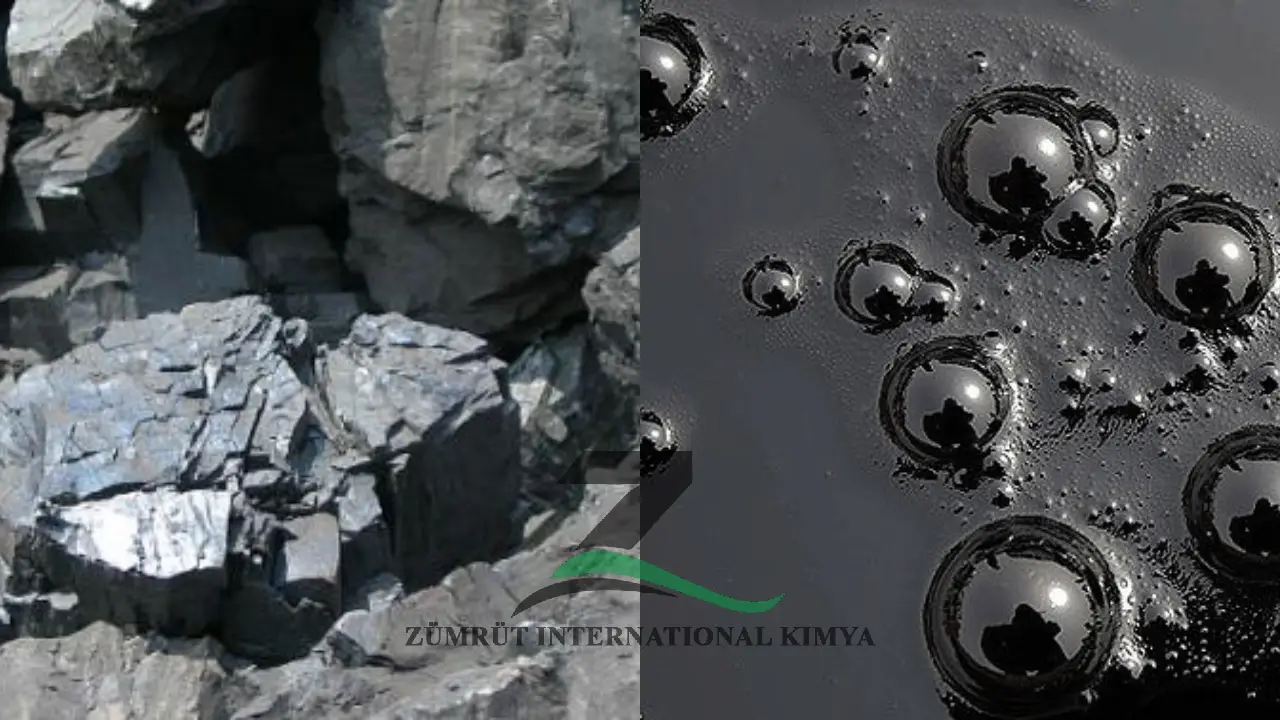
Unlike bitumen, gilsonite is mined directly from the earth as a solid black material with a shiny, glassy appearance. It is brittle at room temperature and can be crushed into dark brown or black powder. It contains a very high concentration of asphaltenes and nitrogen compounds, giving it uniquely high softening points (160–220°C for standard grades) and excellent binding characteristics.
Bitumen (Petroleum Asphalt)
Bitumen is a viscous, black, semi-solid or liquid petroleum-derived material produced as the heaviest fraction during the fractional distillation of crude oil. It is a manufactured product of the petroleum refining process, unlike gilsonite which is natural. Bitumen is the world’s most widely used road construction material, applied in everything from highway paving and airport runways to roofing membranes and waterproofing systems.
Bitumen is classified by penetration grade (e.g., 60/70, 80/100) or performance grade (PG), with different grades optimized for different climatic and traffic conditions. Standard penetration-grade bitumen has softening points ranging from 42–56°C — far lower than gilsonite.
Gilsonite vs Bitumen: Key Differences at a Glance
| Property | Gilsonite (Natural Asphalt) | Bitumen (Petroleum) |
|---|---|---|
| Origin / Source | Natural — mined from earth veins | Refined — petroleum distillation byproduct |
| Physical State (at 25°C) | Solid, brittle, glassy black | Semi-solid to viscous liquid |
| Softening Point | 160–220°C (high-grade) | 42–56°C (penetration grade) |
| Penetration (25°C) | 0 (completely hard) | 60–100 × 0.1 mm (standard grades) |
| Asphaltene Content | 60–80% | 5–25% |
| Nitrogen Content | 3–4% (high) | 0.2–1% (low) |
| Specific Gravity | 1.01–1.20 (varies by grade) | 1.01–1.06 |
| Solubility in CS₂ | 70–90% | ≥ 99.5% |
| Flash Point | > 290°C | ≥ 250°C |
| Rutting Resistance | Excellent | Moderate (grade-dependent) |
| Thermal Stability | Very High | Moderate |
| Price (per MT, FOB) | $350–$500+ (grade-dependent) | $280–$420 (60/70 grade) |
| Availability | Limited (Iran, USA primary sources) | Global — widely available |
| Primary Use | Additive, modifier, drilling fluid, inks | Road paving, waterproofing, roofing |
Physical & Chemical Properties: Deep Comparison
1. Softening Point — The Most Critical Difference
The softening point is perhaps the single most important differentiator between gilsonite and bitumen. Standard penetration-grade bitumen (60/70) has a softening point of 49–56°C — meaning it begins to lose rigidity at relatively low pavement temperatures common in hot climates. Gilsonite, by contrast, has a softening point of 160–220°C depending on the ash content grade.
This enormous gap — over 100°C — means gilsonite maintains structural integrity at temperatures where standard bitumen would deform and flow. This is why gilsonite is widely used as a bitumen modifier in high-performance asphalt for heavily trafficked roads and hot climate applications.
2. Asphaltene Content — Hardness and Binding Strength
Asphaltenes are the high-molecular-weight fraction of hydrocarbon materials responsible for hardness, cohesion, and thermal stability. Gilsonite contains 60–80% asphaltenes — dramatically higher than bitumen’s 5–25%. This is the chemical reason gilsonite is so much harder, more thermally stable, and more effective as a binder in demanding applications.
When gilsonite is added to bitumen (typically at 3–10% by weight of the mix), the asphaltene content of the blend increases significantly, raising the softening point, improving rutting resistance, and reducing temperature susceptibility of the final asphalt product.
3. Nitrogen Content — Why It Matters for Drilling
Gilsonite’s high nitrogen content (3–4%) is one of its most distinctive chemical characteristics. Nitrogen-containing compounds in gilsonite create strong polar interactions with clay minerals and shale formations. This is the scientific basis for gilsonite’s effectiveness as a shale stabilizer in oil and gas drilling fluids — a property that petroleum bitumen simply does not possess at comparable levels.
4. Solubility — A Key Practical Difference
Bitumen is almost completely soluble in carbon disulfide (CS₂) at ≥99.5%, while gilsonite has a lower solubility of 70–90%. This difference reflects the higher inorganic ash content in gilsonite (5–20% depending on grade). For practical applications, gilsonite’s partial insolubility is not a limitation — it contributes to its durability and resistance to chemical attack in industrial environments.
Applications: Where Each Material Excels
🟢 Gilsonite Best Applications
- ✓Oil & gas drilling fluids (fluid loss control, shale stabilization)
- ✓Well cementing (improved flexibility and reduced fluid loss)
- ✓Asphalt modifier (raising softening point, reducing rutting)
- ✓High-performance black printing inks and paints
- ✓Foundry sand binder (improved mold strength)
- ✓Pipe coating and anti-corrosion applications
- ✓Protective coatings and industrial adhesives
- ✓Rubber and polymer performance enhancement
🟩 Bitumen Best Applications
- ✓Standard highway and road paving (hot mix asphalt)
- ✓Airport runways and taxiways
- ✓Roofing and waterproofing membranes
- ✓Bridge deck waterproofing
- ✓Bitumen emulsion (spray sealing, surface dressing)
- ✓Underground pipe coating and wrapping
- ✓Sound dampening materials in automotive
- ✓Industrial floor coatings and sealants
Gilsonite vs Bitumen in Road Construction
Road construction is perhaps the most important arena for comparing gilsonite and bitumen. Standard road paving relies almost entirely on petroleum bitumen as the binder in hot mix asphalt (HMA). However, in projects requiring enhanced performance — particularly in hot climates, under heavy traffic, or on high-load routes — gilsonite is used as an additive to modify bitumen.
How Gilsonite Improves Bitumen Performance in Roads
When gilsonite is blended into hot bitumen at typical dosages of 3–8% by weight, the resulting modified binder shows measurable improvements across multiple performance parameters:
| Performance Parameter | Standard Bitumen 60/70 | Bitumen + 5% Gilsonite |
|---|---|---|
| Softening Point | 49–56°C | 58–68°C (+12°C avg) |
| Rutting Resistance | Moderate | Significantly Improved |
| Penetration (25°C) | 60–70 × 0.1 mm | 40–55 × 0.1 mm (harder) |
| Viscosity at 135°C | Standard | Higher (better coating) |
| Aging Resistance | Moderate | Improved |
| Cost Impact | Base cost | +8–15% material cost |
Key insight: Adding just 5% gilsonite by weight to standard bitumen 60/70 can raise the softening point by 10–15°C — achieving performance comparable to expensive polymer-modified bitumen (PMB) at a fraction of the cost. This makes gilsonite-modified bitumen particularly attractive for contractors in hot climates seeking cost-effective performance enhancement.
Gilsonite vs Bitumen in Oil & Gas Drilling
The drilling industry is where gilsonite’s superiority over bitumen is most clear-cut. Both materials are used in drilling fluid formulations, but for fundamentally different mechanisms and at very different performance levels.
Why Gilsonite is Preferred in Drilling Fluids
Gilsonite acts as a multi-functional additive in water-based and oil-based drilling muds. Its effectiveness is due to three distinct mechanisms that petroleum bitumen cannot fully replicate:
1. Fluid Loss Control (FLC): When gilsonite particles come into contact with permeable formations under wellbore pressure, they soften and deform at elevated temperatures to physically plug pores and microfractures. This sealing mechanism is highly effective at bottom-hole temperatures of 150°C and above, where gilsonite’s high softening point (160–220°C) ensures the particles remain functional without dissolving into the fluid.
2. Shale Stabilization: Gilsonite’s high nitrogen content creates strong chemical interaction with clay minerals in reactive shale formations. This inhibits shale hydration and swelling — one of the primary causes of wellbore instability. This nitrogen-based interaction is not replicated by petroleum bitumen, making gilsonite essentially irreplaceable for this function in water-based muds.
3. Lost Circulation Control: In fractured or vugular formations where drilling fluid is lost into the formation rather than being circulated back to surface, gilsonite acts as a lost circulation material (LCM). Its particle size distribution (available in fine, medium, and coarse grades) can be matched to the fracture apertures to seal the formation and restore circulation.
| Drilling Parameter | Gilsonite | Petroleum Bitumen |
|---|---|---|
| Fluid Loss Control | Excellent | Moderate |
| Shale Stabilization | Excellent (N-compounds) | Poor |
| HPHT Performance (>150°C) | Very Good | Poor (melts/dissolves) |
| Lost Circulation Control | Good | Limited |
| Compatible with WBM | Yes | Limited |
| Cost | Higher | Lower |
Price Comparison: Gilsonite vs Bitumen
Price is one of the primary practical considerations when choosing between gilsonite and bitumen. As of 2026, the following FOB Turkey price ranges apply:
| Product | FOB Price ($/MT) | Grade / Notes |
|---|---|---|
| Bitumen 60/70 | $280–$350 | Standard penetration grade |
| Bitumen 80/100 | $270–$340 | Standard penetration grade |
| Gilsonite Lump (5–10% ash) | $350–$420 | Natural lump form |
| Gilsonite Granule (10–15% ash) | $370–$440 | Granulated, easy handling |
| Gilsonite Powder -200 mesh | $390–$500 | Micronized, drilling / inks grade |
| Polymer Modified Bitumen (PMB) | $480–$650 | SBS/APP modified — for comparison |
Cost perspective: While gilsonite is more expensive per ton than standard bitumen, gilsonite-modified bitumen (using 3–8% gilsonite) provides performance close to PMB at significantly lower total cost. For a contractor choosing between standard bitumen, gilsonite-modified bitumen, and full PMB, the gilsonite option often represents the best value for high-performance applications in hot climates.
Which Should You Choose?
🔍 Selection Guide
→
→
→
→
→
→
Frequently Asked Questions
Related Pages
Gilsonite Overview
Natural asphalt specs and properties
Gilsonite Price 2026
Live FOB Iskenderun price updates
Gilsonite in Drilling
Fluid loss control and shale stabilization
Gilsonite in Asphalt
Road performance enhancement
Bitumen 60/70
Standard penetration grade bitumen
Micronized Gilsonite Powder
-200 mesh powder for inks and drilling
Need Gilsonite or Bitumen? Get a Quote Today
Zumrut International Kimya supplies both gilsonite (all grades) and bitumen (all penetration grades) FOB Iskenderun and Mersin. 24-hour quote response. Full COA documentation included.