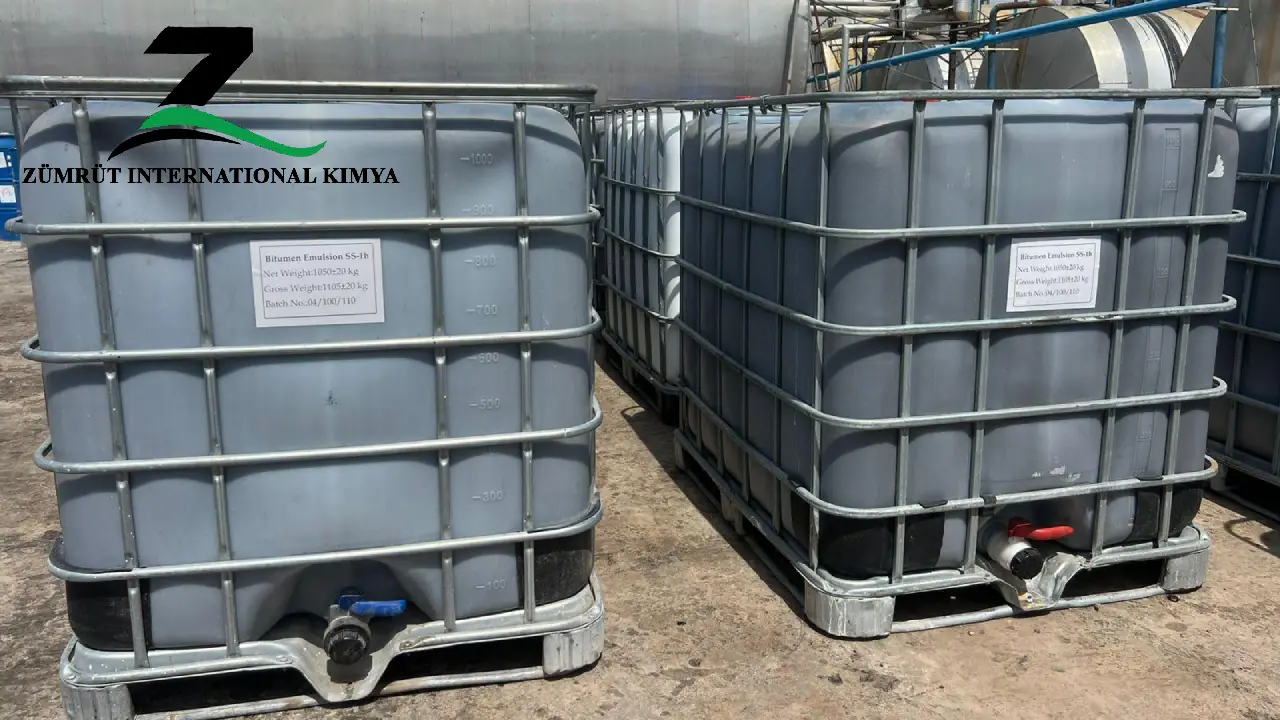
- Key Properties of Anionic Bitumen Emulsion SS-1h
- ASTM D977 Full Specification — Anionic Bitumen Emulsion SS-1h
- FOB Price — Anionic Bitumen Emulsion SS-1h
- Why SS-1h for Hot Climates? The Technical Case
- Applications of Anionic Bitumen Emulsion SS-1h
- SS-1h vs SS-1 — Complete Comparison
- Dilution Guide for SS-1h
- Packaging & Shipping
- Export Destinations
- Frequently Asked Questions — Anionic Bitumen Emulsion SS-1h
- What does the “h” mean in SS-1h bitumen emulsion?
- What is the application rate of SS-1h as a tack coat?
- What is the difference between SS-1h and CSS-1h?
- Can SS-1h be used on concrete surfaces?
- How long does SS-1h take to break before overlay?
- What is the shelf life of SS-1h bitumen emulsion?
- Is SS-1h approved for airport runway applications?
- Related Products
Key Properties of Anionic Bitumen Emulsion SS-1h
| Property | Value |
|---|---|
| Emulsion Type | Anionic, Slow-Setting, Hard Residue (SS-1h) |
| Bitumen Residue Content | 57% minimum |
| Residue Penetration at 25°C | 40–90 dmm (harder than SS-1) |
| Particle Charge | Negative (Anionic) |
| Particle Size | 0.1–5 micron |
| Viscosity (SFS at 25°C) | 20–100 seconds |
| Base Bitumen | Penetration Grade 40/50 or 60/70 |
| Standard | ASTM D977 / AASHTO M140 |
| CAS Number | 68131-77-1 |
| HS Code | 2715.00.00 |
| Application Temperature | Ambient — no heating required |
ASTM D977 Full Specification — Anionic Bitumen Emulsion SS-1h
| Property | Min | Max | Test Method |
|---|---|---|---|
| Viscosity, SFS at 25°C, sec | 20 | 100 | ASTM D244 |
| Residue by distillation, % | 57 | — | ASTM D244 |
| Oil distillate by volume of emulsion, % | — | 3 | ASTM D244 |
| Storage stability test 24hr, % | — | 1 | ASTM D6930 |
| Cement mixing, % | — | 2 | ASTM D244 |
| Sieve test, % | — | 0.1 | ASTM D6933 |
| Tests on Residue from Distillation | |||
| Penetration at 25°C, dmm | 40 | 90 | ASTM D5 |
| Ductility at 25°C, cm | 40 | — | ASTM D113 |
| Solubility in trichloroethylene, % | 97.5 | — | ASTM D2042 |
FOB Price — Anionic Bitumen Emulsion SS-1h
Why SS-1h for Hot Climates? The Technical Case
The defining characteristic of SS-1h is the hardness of its bitumen residue. When a tack coat is applied in regions where pavement surface temperatures regularly exceed 50–60°C — common across Nigeria, Kenya, Iraq, Bangladesh, and the UAE — a soft residual bitumen (as found in standard SS-1 with penetration 100–200 dmm) can become viscous enough to allow slippage between pavement layers under traffic loading. This slippage creates a failure plane, leading to delamination, wheel-path cracking, and premature pothole formation.
SS-1h’s residue penetration of 40–90 dmm at 25°C means its softening point is significantly higher. The bonded interlayer remains stable under elevated pavement temperatures, locking the asphalt overlay firmly to the existing surface and preventing the relative movement that causes delamination. This is why road authorities in Sub-Saharan Africa, the Middle East, and South Asia commonly specify SS-1h — not SS-1 — as the tack coat grade for highways, airport aprons, and urban arterials.
Applications of Anionic Bitumen Emulsion SS-1h
Tack Coat — the primary application (0.2–0.5 L/m²): SS-1h is sprayed onto the surface of existing asphalt, concrete, or milled pavement before placement of a new asphalt overlay. The hard residue bonds the two layers into a single structural unit, preventing slippage planes and delamination under traffic. Application rate is calibrated to pavement condition: 0.2–0.3 L/m² on clean, dense-graded surfaces; 0.4–0.5 L/m² on milled, oxidised, or porous surfaces. The emulsion must break completely and appear uniformly black before the overlay is placed.
Prime Coat (0.5–1.0 L/m²): Applied to granular or stabilised base courses before asphalt overlay to bind loose aggregate particles, waterproof the base, and promote adhesion. SS-1h can be diluted up to 1:1 with water for better penetration into porous bases. It serves as a solvent-free, flame-free alternative to cutback bitumen prime coats in urban areas and environmentally regulated sites.
Fog Seal (0.3–0.6 L/m², diluted 1:1): Sprayed onto oxidised or aged asphalt surfaces to restore surface flexibility, seal micro-cracks, and reduce ravelling. The harder residue of SS-1h compared to SS-1 makes it more suitable for fog sealing high-traffic roads where a firmer sealing film is needed to resist tracking under tyre pressure.
Chip Seal (surface dressing): SS-1h is used as the binder in chip seal (single or double surface dressing) operations. The emulsion is sprayed at 0.8–1.5 L/m², followed immediately by aggregate chipping, compacted by a pneumatic roller. The hard residue holds the aggregate firmly in place even under heavy traffic and high pavement temperatures — a common failure mode when softer grades are used in hot climates.
Slurry Seal: Combined with fine aggregate, mineral filler, water, and additives to produce a slurry mix spread over the pavement surface. SS-1h’s harder residue provides better durability and resistance to traffic wear compared to SS-1 in warm-climate slurry seal applications.
Dense-Graded Cold Mix: SS-1h is mixed with well-graded aggregate at a plant or in-situ for stockpile patching material. The slow-setting nature ensures extended workability during mixing, while the hard residue provides structural stability after curing.
Dust Control on Unpaved Roads (diluted 1:2 with water): Applied at 0.5–1.5 L/m² to bind loose surface material on unpaved and laterite roads, reducing dust and stabilising the running surface during dry season operations.
SS-1h vs SS-1 — Complete Comparison
| Feature | SS-1h | SS-1 |
|---|---|---|
| Residue Penetration | 40–90 dmm (harder) ✓ | 100–200 dmm (softer) |
| Hot Climate Performance | Excellent ✓ | Moderate |
| Rutting Resistance | Higher ✓ | Standard |
| Interlayer Bond Strength | Higher ✓ | Standard |
| Chip Seal Suitability | Excellent ✓ | Good |
| Fog Seal Flexibility | Good | Better ✓ |
| Cold Climate Flexibility | Moderate | Better ✓ |
| Best For | Hot climates, tack coat, chip seal | Cooler climates, fog seal, slurry |
Dilution Guide for SS-1h
SS-1h can be diluted with clean, potable water immediately before application. Never dilute with seawater or hard water — mineral salts destabilise the emulsion. Always add water to emulsion, not emulsion to water, and mix gently without air entrainment.
| Application | Dilution Ratio (Emulsion:Water) | Application Rate |
|---|---|---|
| Tack Coat (dense surface) | Undiluted | 0.2–0.3 L/m² |
| Tack Coat (milled/porous) | Undiluted | 0.4–0.5 L/m² |
| Prime Coat | 1:1 | 0.5–1.0 L/m² |
| Fog Seal | 1:1 | 0.3–0.6 L/m² |
| Dust Control | 1:2 | 0.5–1.5 L/m² |
Packaging & Shipping
Anionic Bitumen Emulsion SS-1h is exported in new steel drums (200 litres, sealed on pallets), IBC tanks (1,000 litres), or flexi tanks (16,000–20,000 litres in a 20ft container). Flexi tank is the most economical option for large-volume orders destined for port terminals in East and West Africa. Bulk tanker supply is available ex-Iskenderun and ex-Jebel Ali for customers with local storage facilities.
Storage requirements: keep above 5°C and below 60°C, protected from direct sunlight and freezing. Do not heat above 70°C. Shelf life is 3–6 months from production date in sealed, undisturbed containers. Do not mix with cationic emulsions — immediate coalescence will occur.
Export Destinations
Zumrut International Kimya supplies Anionic Bitumen Emulsion SS-1h to road construction contractors, government road authorities, and bitumen traders across East Africa (Kenya, Tanzania, Ethiopia, Uganda, Mozambique, Rwanda), West Africa (Nigeria, Ghana, Senegal, Ivory Coast, Cameroon), the Middle East (Iraq, Jordan, Yemen, Oman, Kuwait, Saudi Arabia), and South Asia (Bangladesh, Sri Lanka, Pakistan, India). Shipments depart from Iskenderun Port (Turkey) and Jebel Ali Port (UAE) with typical lead times of 14–30 days from order confirmation.
Frequently Asked Questions — Anionic Bitumen Emulsion SS-1h
What does the “h” mean in SS-1h bitumen emulsion?
“h” stands for hard — referring to the harder, lower-penetration bitumen residue (40–90 dmm at 25°C) that remains after the water phase evaporates. This is the only technical difference between SS-1h and SS-1 (which has a softer residue of 100–200 dmm). The harder residue gives SS-1h better rutting resistance and interlayer bond strength in hot climates, making it the preferred tack coat grade for road projects in Africa, the Middle East, and South Asia where pavement surface temperatures regularly exceed 50°C.
What is the application rate of SS-1h as a tack coat?
The standard tack coat application rate for SS-1h is 0.2–0.5 L/m² undiluted, depending on the condition of the surface receiving the tack coat. Clean, dense-graded existing asphalt requires 0.2–0.3 L/m². Milled, oxidised, or open-graded surfaces require 0.4–0.5 L/m². The emulsion must be allowed to break completely — changing from brown to uniformly black — before the asphalt overlay is placed. Placing hot mix on unbroken emulsion causes steam blistering and bond failure.
What is the difference between SS-1h and CSS-1h?
SS-1h is an anionic slow-setting emulsion — its bitumen particles carry a negative charge and bond best with basic or limestone aggregates. CSS-1h is a cationic version with identical “h” (hard residue) characteristic but positively charged particles that bond more effectively with acidic or siliceous aggregates (granite, quartzite, basalt). In terms of rutting resistance and tack coat performance in hot climates, both perform similarly — the choice depends on the aggregate type and local road authority specification.
Can SS-1h be used on concrete surfaces?
Yes — SS-1h is commonly used as a tack coat between Portland cement concrete (PCC) surfaces and asphalt overlays. Anionic emulsions are particularly well-suited for concrete interfaces because the negatively charged bitumen particles react with the alkaline cement surface to form a water-insoluble bond, improving long-term adhesion. The concrete surface must be clean, structurally sound, and free from curing compounds before application.
How long does SS-1h take to break before overlay?
Under typical conditions (25–35°C ambient, moderate humidity), SS-1h breaks in 30–90 minutes after application. At higher temperatures (35–45°C) in direct sunlight, breaking can occur within 15–30 minutes. In high humidity or overcast conditions, breaking may take 90–120 minutes. The emulsion has broken when the colour changes uniformly from brown to black across the entire treated area. Do not allow traffic or construction equipment on unbroken emulsion.
What is the shelf life of SS-1h bitumen emulsion?
When stored in sealed containers between 5°C and 60°C, away from direct sunlight and freezing conditions, SS-1h has a shelf life of 3–6 months from production date. ASTM D977 requires a maximum settlement of 1% after 24 hours, confirming excellent storage stability. Containers must not be stored in sub-zero temperatures — ice crystal formation permanently destabilises the emulsion structure and it cannot be recovered by reheating.
Is SS-1h approved for airport runway applications?
SS-1h meets the emulsion specifications used in airfield pavement maintenance as a tack coat between asphalt overlay lifts on taxiways, aprons, and runway shoulders. For airside applications, always verify the current FAA or ICAO specification requirements applicable to the project, as airport authorities may specify cationic emulsions or polymer-modified variants for critical airside areas. Our technical team can provide product documentation and test certificates to support specification approval processes.
Related Products
Anionic Bitumen Emulsion SS-1 |
Cationic Bitumen Emulsion CSS-1h |
Cationic Bitumen Emulsion CSS-1 |
Anionic Bitumen Emulsion MS-2 |
Anionic Bitumen Emulsion Hub |
Bitumen Emulsion
Request a Quote for Anionic Bitumen Emulsion SS-1h
Tell us your required quantity, packing type, and destination port. We will provide FOB and CFR pricing within 24 hours.
| Contact Us | WhatsApp Turkey | WhatsApp UAE |